Hungary has been one of Europe’s established dental tourism destinations for decades. Patients from Austria, Germany, Switzerland, the United Kingdom, and other European countries regularly travel there for dental treatment that may cost considerably less than equivalent private care at home.
For patients considering a Hollywood Smile in Hungary, however, price is only one part of the decision. The type of restoration, number of teeth treated, laboratory quality, treatment planning, preparation technique, and aftercare arrangements can all influence the final result.
Why Hungary Became a Major Dental Tourism Destination in Europe
Hungary developed its dental tourism sector long before cosmetic dentistry became heavily promoted through social media. Budapest and western Hungarian cities such as Mosonmagyaróvár and Sopron have treated international dental patients for many years.
Several factors have contributed to the country’s reputation.
| Factor | What It Means for Patients |
| Dental education | Institutions such as Semmelweis University train dental professionals in an international academic environment. |
| EU regulatory framework | Dental materials and medical devices used within the European Union must meet applicable EU requirements and CE-marking rules. |
| Conservative treatment options | Many clinics offer adhesive and minimally invasive restorative approaches when the condition of the natural teeth allows them. |
| Established dental laboratories | Budapest has access to digital dental laboratories using CAD/CAM systems and modern ceramic materials. |
For international patients, these factors can make Hungary attractive when they want treatment within the European Union while still reducing costs compared with private dentistry in countries such as the UK.
However, standards and treatment philosophies still vary between individual dentists and clinics. The country alone does not determine the quality of treatment.
Hollywood Smile Cost Breakdown in Hungary
A full Hollywood Smile may involve 16 to 20 restorations, commonly covering 8 to 10 visible teeth in each arch. Some patients treat only the upper teeth, while others require a combination of veneers, crowns, whitening, orthodontics, or other procedures.
The final treatment plan should therefore depend on the condition of the teeth rather than a predetermined number of restorations.
Hungarian clinics commonly price cosmetic restorations per tooth, making it easier to understand how the total quote is calculated.
Realistic Price Ranges in Hungary
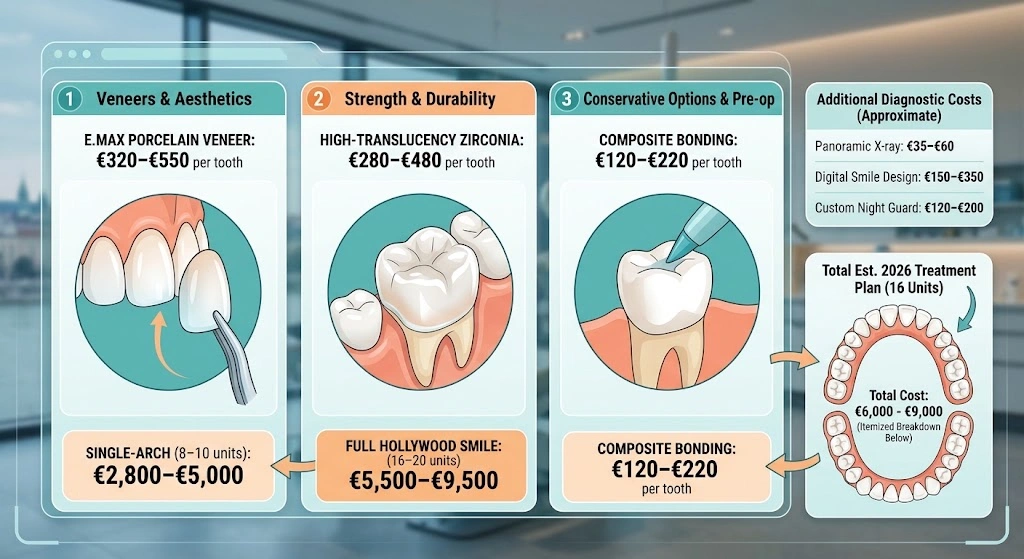
Typical 2026 price ranges may look like this:
- E.max porcelain veneer: €320–€550 per tooth
- High-translucency zirconia restoration: €280–€480 per tooth
- Direct composite bonding or composite veneer: €120–€220 per tooth
- Single-arch smile makeover with 8–10 units: €2,800–€5,000
- Full Hollywood Smile with 16–20 units: €5,500–€9,500
These figures should be treated as general reference ranges rather than fixed treatment prices. Tooth condition, laboratory work, material selection, additional procedures, and clinic location can change the final quote.
Additional Diagnostic and Treatment Costs
The advertised price for veneers or crowns may not represent the complete treatment cost.
Depending on the clinic and your dental condition, additional expenses may include:
- Initial consultation and clinical examination: free with treatment at some clinics, or approximately €40–€70
- Panoramic dental X-ray: approximately €35–€60
- 3D CBCT scan when clinically required: approximately €90–€160
- Digital Smile Design or diagnostic mock-up: approximately €150–€350
- Custom night guard: approximately €120–€200
Before comparing clinics, ask for an itemized treatment plan showing what is included and what may be charged separately.
Hungary vs. Turkey, the UK, Poland, and Spain
Comparing the Hollywood Smile cost in Hungary with other countries helps put Hungarian prices into context.
| Country | E.max Veneer per Tooth | Full Hollywood Smile (16–20 Units) | Key Considerations |
| Hungary | €320–€550 | €5,500–€9,500 | EU location, itemized treatment plans, established dental tourism sector |
| Turkey | €180–€350 | €3,500–€7,000 | Lower overall prices and widespread dental tourism packages |
| Poland | €350–€600 | €6,500–€11,000 | EU destination with established dental laboratories |
| United Kingdom | €820–€1,640 (£700–£1,400) | €16,400–€30,500 (£14,000–£26,000) | Higher private treatment costs but easier local follow-up |
| Spain | €450–€750 | €8,000–€14,000 | EU destination with a strong cosmetic dentistry market |
Prices alone should not determine where treatment is performed. Patients should also compare the planned restoration type, amount of tooth preparation, dentist’s qualifications, laboratory standards, aftercare policy, and time available for treatment.
Hungary vs. Turkey
Budapest and Istanbul are both established dental tourism destinations, but their markets often operate differently.
Turkey is particularly known for competitive package pricing, with some clinics combining dental treatment with accommodation and airport transfers.
Hungarian clinics more commonly use itemized pricing, allowing patients to see the cost of individual restorations and additional procedures separately.
The more important comparison, however, is not simply Hungary vs. Turkey. Patients should compare the actual treatment plans offered by individual dentists.
A lower quote may involve different materials, a different number of teeth, crowns instead of veneers, or fewer diagnostic and follow-up services.
Materials Used for a Hollywood Smile in Hungary
Two ceramic materials frequently discussed when planning a Hollywood Smile are E.max lithium disilicate and zirconia.
They have different optical and mechanical properties, so one material is not automatically better for every tooth.
| E.max / Lithium Disilicate | High-Translucency Zirconia | |
| Material type | Glass ceramic | Ceramic oxide |
| Main advantage | Natural translucency and aesthetic appearance | High strength and durability |
| Common use | Veneers and aesthetic anterior restorations | Crowns, bridges, heavily loaded areas, selected aesthetic cases |
| Bonding | Can be adhesively bonded after appropriate surface treatment | Bonding protocol depends on restoration design and zirconia type |
| Best choice depends on | Tooth structure, color, position, bite, and treatment goal | Tooth structure, color, position, bite, and treatment goal |
IPS e.max
E.max lithium disilicate is widely used for aesthetic restorations because it can reproduce the translucency, brightness, and depth of natural enamel.
For suitable front teeth, thin ceramic veneers may allow the dentist to change tooth color, proportion, shape, or symmetry while preserving more natural tooth structure than a full crown.
High-Translucency Zirconia
Modern zirconia materials can also provide good aesthetic results while offering greater strength in situations where higher mechanical resistance is required.
They may be considered for crowns, bridges, heavily restored teeth, significant discoloration, or patients with stronger bite forces.
Material selection should ultimately follow the clinical condition of each tooth rather than the name of the material alone.
What Does the Treatment Journey in Budapest Look Like?
A multi-tooth cosmetic case in Budapest may require one extended stay of approximately 5 to 8 working days or more than one visit, depending on the treatment plan.
Complex treatment should allow enough time for diagnosis, laboratory work, try-ins, adjustments, and final bite evaluation.
A typical workflow may include:
Days 1–2: Examination, scans, treatment planning, mock-up, and tooth preparation when required
Days 3–5: Laboratory fabrication and temporary restorations
Days 6–7: Ceramic try-in, final bonding or cementation, and bite adjustments
The exact schedule varies between clinics and cases.
Stage 1: Assessment, Scans, and Trial Smile
Treatment normally begins with a clinical examination and diagnostic records.
The dentist may assess:
- Teeth and existing restorations
- Gum condition
- Bite and jaw function
- Tooth alignment
- Available enamel
- Tooth color and proportions
Digital scans or impressions can then be used to plan the proposed smile.
Patients may also discuss tooth shape, shade, smile width, and how natural or bright they want the final appearance to be.
If tooth preparation is required, the amount removed should depend on the existing tooth position and the restoration design rather than a standard depth applied to every patient.
Temporary restorations may then protect prepared teeth and give the patient an opportunity to evaluate basic shape, length, speech, and bite before the final ceramics are completed.
Stage 2: Laboratory Fabrication
Once the treatment design is approved, the dental laboratory begins producing the final restorations.
Depending on the selected technique, technicians may mill, press, stain, glaze, or layer the ceramic to reproduce the planned tooth shape, shade, translucency, and surface texture.
Laboratory quality can have a major influence on the final appearance of a multi-tooth smile makeover.
Stage 3: Try-In, Bonding, and Bite Adjustment
Before final placement, the dentist should evaluate the fit, margins, color, shape, contacts, and relationship between the upper and lower teeth.
For veneers, temporary try-in materials may allow the patient and dentist to preview the appearance before permanent bonding.
After approval, the teeth and ceramic surfaces are prepared according to the selected bonding protocol, and the restorations are secured using an appropriate dental resin cement.
The dentist then checks the bite and makes any necessary adjustments.
For international patients, scheduling enough time for a final bite check before flying home can make follow-up easier.
Risks and Complications to Consider
Traveling abroad for cosmetic dentistry can reduce treatment costs, but it can also make follow-up care more complicated.
The main risks are related not specifically to Hungary, but to cosmetic restorative treatment and cross-border dentistry in general.
| Potential Issue | Why It Matters |
| Excessive tooth preparation | Removing unnecessary enamel or dentin is irreversible and may increase sensitivity or future restorative needs. |
| Bite problems | Poorly adjusted restorations may create discomfort, tenderness, or uneven chewing forces. |
| Long-distance aftercare | Returning to the original treating dentist may require additional travel. |
| Repair costs at home | Local dentists may charge separately for examinations, repairs, or replacement restorations. |
| Communication problems | Expectations about tooth shape, shade, and preparation should be clearly understood before treatment begins. |
Post-Treatment Bite Adjustments
A restoration can look excellent while still requiring minor bite adjustments.
Once local anesthesia wears off and the patient begins eating normally, previously unnoticed high points may become more apparent.
For this reason, patients should ask whether the clinic provides a final occlusion check after permanent placement and before departure.
Cross-Border Aftercare and Warranties
Some Hungarian clinics provide written warranties for ceramic restorations, but the terms vary considerably.
Before treatment, ask:
- What problems are covered?
- How long does the warranty last?
- Are accidental fractures covered?
- Is treatment free but travel excluded?
- What happens if the restoration fails after you return home?
- Can repairs be completed locally?
A warranty is only useful when you clearly understand what it includes.
Communicating Expectations
Cosmetic dentistry involves details that can be difficult to explain after the restorations have already been produced.
Before treatment begins, discuss preferences such as:
- Tooth length
- Tooth width
- Incisal edge shape
- Smile curve
- Shade
- Surface texture
- Degree of translucency
- Natural versus highly uniform appearance
Photographs, digital simulations, and temporary mock-ups can help make these preferences easier to communicate.
How to Choose a Dental Clinic in Hungary
A lower price should never replace proper due diligence.
Before paying a deposit or booking non-refundable travel, review the following points:
- Check the dentist’s professional credentials. Verify that the treating dentist is appropriately registered to practice in Hungary and has relevant experience in restorative or aesthetic dentistry.
- Clarify veneers versus crowns. Your treatment plan should clearly state which teeth will receive veneers, crowns, or other restorations.
- Ask how much tooth preparation is expected. Treatment should be based on the condition and position of each tooth.
- Ask which materials will be used. Confirm the ceramic system, restoration type, and whether the quoted price includes laboratory work.
- Learn where the restorations are produced. Ask whether the clinic uses an in-house laboratory or an external dental laboratory.
- Review clinical photography carefully. Look beyond highly edited before-and-after images and pay attention to tooth proportions, gum margins, and overall natural appearance.
- Understand the aftercare policy. Ask what happens if you experience sensitivity, bite problems, debonding, or fracture after returning home.
- Allow enough time for treatment. Complex multi-unit ceramic treatment should include adequate time for laboratory work, try-ins, and adjustments.
Frequently Asked Questions
Hollywood Smile in Hungary: What to Consider Before Booking
Hungary remains an established option for patients comparing cosmetic dental treatment within Europe. Prices can be considerably lower than private treatment in the UK and some Western European countries, while Budapest offers access to experienced dental teams and modern laboratory technology.
However, the country and the price should not be the only reasons for choosing a clinic.
Before committing to a Hollywood Smile in Hungary, compare the exact treatment plan, restoration type, amount of tooth preparation, materials, laboratory process, treatment timeline, and aftercare policy.
The strongest treatment plan is not necessarily the cheapest or the fastest. It is the one that matches the condition of your teeth while preserving healthy tooth structure whenever clinically possible.
Have questions about a Hollywood Smile?
Enter your phone number and we’ll call to answer general questions and explain your options.